

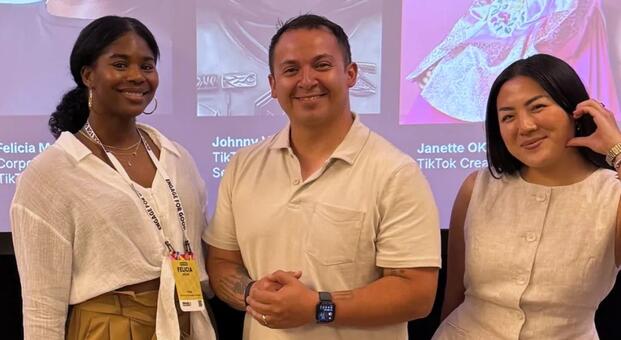
Sgt. First Class Johnny Vargas may have fallen into being a content creator by accident, but two years into his new life, he’s built a booming social media business with no plans of looking back.
Vargas serves in the Army as a non-commissioned officer (NCO). His salary is nearly $90,000 a year, certainly not chump change, but Vargas said in a recent interview with Military.com that he makes “way more” through social media and consulting work for businesses. While he wouldn’t specify how much he earns, it’s clear Vargas puts in the work, producing videos about military and veteran news multiple times per day on TikTok, YouTube, Instagram, and Facebook.
After a silly video posted by his wife went viral in 2023, Vargas wasn’t planning on gaining a following, but he knew something was there. He learned the nuances of social media engagement and how to build an audience. Eventually, military brass caught wind of Vargas’s growing popularity and signed him on to help with military recruitment.
His social media platforms have unlocked many doors, and Vargas plans to keep growing his business after he receives a medical retirement from the Army next summer. Vargas believes if he can do it, other veterans and active-duty military members can too. Vargas shares how in this Q&A with Military.com.

Army Sergeant to Content Creator
Kevin Damask (KD, Military.com): What attracted you to the Army, and how did you get involved in the service?
Johnny Vargas (JV): Well, I don’t have a lot of deep-rooted military background in my family. But my grandfather was in the Korean War. He was a canon crew member, and my uncle was in the Marine Corps Reserves in California. But I grew up in the San Fernando Valley of California, and I wanted to be a firefighter, and to be honest, it was just a whole lot easier to join the military. I joined on Jan. 1, 2013, and it’s been a journey. Kind of crazy ever since.
KD: Do you consider yourself a “social media influencer?”
JV: A lot of people would justify us as being in that space, but we don’t use the “I-word,” just because it sort of puts you in a bubble. That word “influencer” is almost like a cuss word. I like to use content creator, informer, or educator. I’m also a media manager and social media consultant. I work with a lot of companies, both for-profit and non-profit.
But I don’t do any of this in an official capacity for the Army or the Department of War. I have a couple of lawyers representing me, and I do this as a registered LLC. And I don’t use my rank or my position as an officer in the Army to bolster my business or my online media presence.
The businesses I work with know they’re working with Johnny and not Sgt. First Class Vargas.
Growth on TikTok
KD: You really took off on TikTok in particular. What attracted you to that platform?
JV: It’s the best platform for immediate growth because one thing TikTok does that other platforms don’t do is that when you make a video, they batch it out to new people that have never seen your content before, as opposed to YouTube, Facebook and Instagram, they batch out to people that already know you or have liked your page. From there, you have to rely on people to share the video or send it to others. With TikTok, they want to grow your audience as quickly as possible because when you grow, they grow. They make it very easy to grow.

They reached out to me about a year and a half ago. I did a segment with a gentleman from National Public Radio who interviewed me on air. I spoke about TikTok and I was advocating for them. Then they reached out and said, “We have a Veterans Voice Initiative that we’re starting. We’re giving $10 million to eight different nonprofit veterans associations. Would you like to be a part of that? I said, “Sure!”
KD: Do you know, as of November 2025, how many social media followers you have?
JV: Across all platforms, it’s probably around 300,000. My reach is about 35 to 45 million users per month.
KD: What are the keys to attracting an audience to start building a loyal following and keep growing it?
JV: Online, I try to be who I am in real life. I don’t put on a fake persona. I’m very genuine, transparent, and honest.
By doing that, I’ve earned the audience’s trust. There are no walls or curtains that I have up between myself, the platform and the audience. And whenever my followers meet me in person, they’re like, “Wow, you really do act this way.” Because there are people on social media that put on a face, put on a show, and they’re really not like that in person.
I think one of the more important things is persistence; you can’t stop until it works. The first year I was doing this, I vowed to myself that I was going to post three videos per day on every single platform, TikTok, Facebook, Instagram and YouTube. I did that for a year straight and I went from zero to like 140,000 followers across all the platforms and now I’ve double that figure.
Besides consistency, I tell people, “Make content for the audience you want, not the audience you have.” Once you figure out who you want to attract and then home in like, “How do I reach them?” There are three pillars on how to do that. 1. You want to make people learn, make them laugh or make them cry. Maybe not physically cry, but you want to tell emotional stories and connect with the audience. I try to have at least one, or a combination of those three elements on every post.

Turning Page Views Into Profits
KD: I’m curious about the business side of social media. How do people make money off being a content creator? Through sponsorships?
JV: So, there are a few ways. Initially, once you gain a certain audience, the platforms monetize you off how many views you get. It’s called a per-mile rate. So, every thousand views equals a certain dollar amount, depending on who you reach.
It ebbs and flows. So, I was getting money from the different platforms for all the views, which was nice, but then you get paid more if you start doing brand work, associations, partnerships, and consulting. I have consulting calls with brands, and I charge an hourly rate to speak with for-profits, non-profit companies, and CEOS, and board members, about what I do on social media and how they could reach a larger audience. I also do keynote speaking.
Somebody told me once, “Johnny, once you treat yourself as a brand, then you’ll start making brand decisions.” So, about a year ago, I started realizing that this is a business and I have this brand to maintain.
KD: When did the Pentagon reach out to you to work with them on making videos?
JV: That was probably over a year ago. They started the Creative Reserve Pilot Program, and they had a pocket of funding. They had to figure out how to reach service members or people interested in joining the military, work on recruitment and messaging.
They contacted me and a few others and asked if we could help, like, “Hey, can you attend these different events, give speeches, take some pictures, and talk about the military, advocate for the Army, and tell your story.” At the same time, this small group at the Pentagon, they were incredible because they encouraged us to not do things we weren’t comfortable with or to not say things about the Army that we didn’t necessarily agree with. So, it was cool to be able to tell my story and not have to “church” it up.
But then some legal barriers came up between them and us. Ultimately, it’s on pause now, so it’s not a thing. The DOD can’t use our name, image, and likeness to promote the military without compensating us more, but at the same time, we’re still servicemembers, so they just can’t compensate us more.
So, they said, “Let’s pause this, do a legal review, and maybe we can hash it out in the future.”
Whenever I do media spots, like on ABC Live for the Veterans Day parade in November, I have to take leave. But it’s great because I get to work with the Bob Woodruff Foundation, Team Rubicon, Student Veterans of America, and all these different people.
KD: When you were producing videos for the Army, were there times when reps said, “You know, Johnny, maybe you shouldn’t have said that?”
JV: Yeah, there were a couple of times, but compared to other content creators in the Army space, I’m pretty clean. I don’t cuss. I don’t make jokes about genitalia. I don’t say racially charged things, and I keep all my clothes on. So, they trusted me a lot, but at the same time, that kind of hurt me sometimes because I was under a magnifying glass.
If I said something that was 2 percent off course to what I normally would say in that safer realm, I would get a couple of calls, like, “Hey, could you maybe word it this way instead?” But they didn’t really tell me to stop doing things. They never said, “We don’t like that, take it down.” They never asked me to delete anything. Sometimes they would say, “This general or this colonel said this about your video,” providing feedback.
At the same time, I cover a lot of military news, and I talk about some very charged-up things. I synthesize the articles to my audience, and I don’t give my opinion. I don’t tell them what to think either. A couple of times, some senior officials reached out and said, “Hey, we don’t like that. You should take it down.” That’s when I said, “No disrespect, but I can’t talk to you. Go ahead and talk to my lawyer.” And my lawyer expressed to them, “Those aren’t Johnny’s words. He didn’t say anything illegal, he didn’t do anything wrong, you just don’t like what he said.” After that, those issues typically go away.
Using Platform to Help Veterans
KD: Besides using your platform to connect with senior leaders in the military, you’ve also connected with leaders at VA to help veterans. How have you used social media to work with those groups?
JV: Well, it was never my intention to become “colleagues” with some of these people in their current positions, but like Tony Grinston, the former sergeant major of the Army, I consider him a friend. He’s now the CEO of Army Emergency Relief. And Dan Daly, he’s with AUSA and is vice president of its soldiers and NCOs program. And more recently, I’ve had a meeting with Secretary of War Pete Hegseth, Doug Collins, the secretary of veterans affairs, and Mike Weimer, the current Sergeant Major of the Army. We’ve all had friendly conversations, and they’ve told me, “Hey, we love what you do on social media,” but for legal purposes, I wouldn’t consider them an endorsement. But it’s cool that I have their support. I’ve been able to have access to them that other people don’t because I’ve earned their trust.

KD: In other interviews, you've talked about promoting mental health care for veterans and active-duty military members. A lot of times, veterans struggle with transitioning out of the military and back into civilian life. Some really go down dark paths, homelessness, depression, addiction, and even suicide. What do you think is the biggest obstacle for veterans when they’re trying to transition out of the military?
JV: Unfortunately, I’ve had friends who have taken their own lives because of the struggle with transitioning. I haven’t gone through it yet, but I’m hoping to have a medical retirement approved in the next several months. I think one of the biggest obstacles is not having enough people to help with the transition.
A lot of servicemembers don’t realize, “Hey, this is over. And I have to get ready for this next chapter.” A lot of them are kind of hardened when they get out and feel like, “Oh no, I don’t need any help,” because we typically do things for ourselves a lot.
Especially for men, it’s very hard to admit when you need help. It feels weak, like we failed at something.
I think another aspect is not having a more focused process for getting service members out. So many soldiers go through it, and it’s just a “check the box” sort of thing. You get briefed on your way out, and you don’t really have to pay attention. They just snap you, though, like, “Yep, this person’s good.” And it’s onto the next appointment.
It’s too much of an umbrella process, and it should be more focused on each servicemember.
KD: Veterans and active-duty military people tend to connect better with those who have gone through similar experiences. Have you used that connection to build your social media following?
JV: Yeah, that’s why I have those pillars. Try to make people cry, and tell emotional, real-life stories because if I can talk about my experiences and maybe something horrible I’ve gone through, maybe it helps one other person who might not have wanted to talk about it or have compartmentalized it. And social media is great for that because I can connect with people really quickly.
KD: You’re an NCO in the Army, and you’re building a robust social media business while married with four children. How do you manage your time?
JV: Yeah, sometimes it’s hard. But I do have assistants who help me with my email inboxes. I still manage my own calendar. I still negotiate all my contracts. Some of the organizations I work for book all of my travel itineraries so that’s one less thing to worry about. But, yeah, juggling raising four kids, my wife, the military, my business, it can be really, really hard. I try to put as much as I can in the pot. Just put it into certain compartments to make sure the other ones aren’t struggling and I’ve just had to say no to some opportunities.
KD: You’re not quite a veteran yet, but what advice do you have for veterans who see you thriving on social media, read your story, and are like, “Hey, I might want to do this too?”
JV: Well, I think this goes for most things in life: You don’t know until you try. And once you try, try hard. So many people don’t put enough effort into certain parts of their lives. If you make it your goal to be mildly successful, you’re only going to be mildly successful. But if you make it your goal to be overwhelmingly successful, and you create steps to get those steps done, then you’re probably going to get there. So, find the end goal and then create the steps between where you are and make sure they’re realistic.


