


The National Museum of the Marine Corps opened its newest display on Jan. 28, 2026, shining a spotlight on the storied history of Marine Corps football. The ribbon-cutting ceremony, where retired Lieutenant Colonel Ron Eckert, the final coach of the Quantico Marines, helped unveil the exhibit and provided remarks, accompanied by kind words from the President of Marine Corps University, Brigadier General Matthew Tracy.
The display highlights a lesser-known chapter of Marine's winning ethos, one perhaps best described in a quote by former Major General Joseph C. Fegan in a 1923 edition of the Marine Corps Gazette:
Fine Young Americans... will go where athletics are encouraged - they, too, like to be on the winning side.

Ceremony Draws Veterans and Family
The event kicked off at 11 a.m. inside the museum, drawing an intimate crowd of Marines, veterans, and family. Eckert, alongside his wife Cathy, cut the red ribbon to officially open the display. Museum Director Keil Gentry highlighted the exhibit's role in showcasing Marine spirit off the battlefield:
This display celebrates teamwork, discipline, and the Marine spirit beyond the battlefield ... It reminds us that competition, resilience, and camaraderie are as much a part of Marine identity as service in combat.
The atmosphere buzzed with nostalgia as attendees shared stories of past games and fond memories. One such noteworthy story Eckert regaled involved the team in flight for the Quantico Marines' final football game against Xavier University in Cincinnati, Ohio. He described how the crew of a passing FedEx plane, en route to Memphis, sang the Marines' Hymn over the radio to honor the team.
Guest of Honor: LtCol Ron Eckert's Role in Marine Football
Eckert, who served as the guest of honor, had provided some personal artifacts to the exhibit. He played for the Quantico Marines himself earlier in his career, then returned after two tours in Vietnam as an assistant coach before becoming head coach in 1971. Under his leadership, the team played its final season in 1972, ending with a 34-0 victory over Xavier. Eckert reflected on the era during the ceremony, noting how the program fostered leadership.
Our world changed dramatically; the penchant for service football dried up
He previously reflected on the post-Vietnam budget cuts that shuttered the team. His donations, including memorabilia from those last seasons, add authenticity to the display. Eckert's presence underscored the program's recruiting value, drawing talented individuals who embodied the Corps' tough, masculine image amid public scrutiny of military involvement in the 1970s.
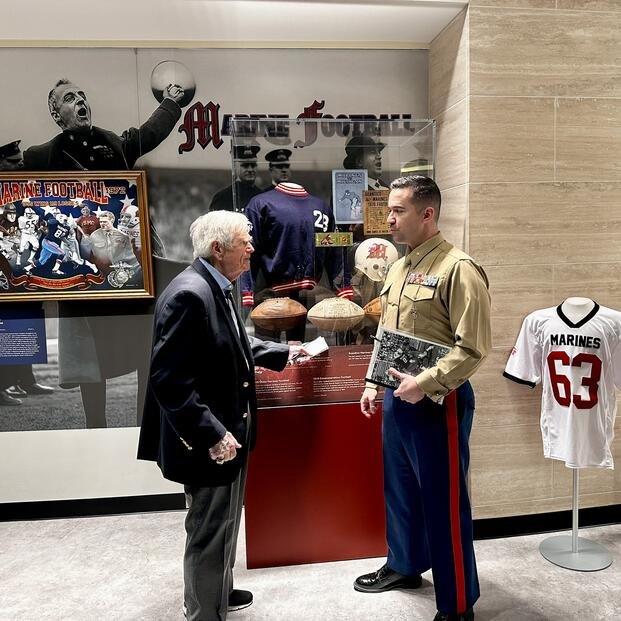
Exhibit Highlights: Artifacts from the Gridiron
Visitors to the Marine football display encounter key artifacts that capture the program's essence. Among them is a 1935 football used by the 4th Marines team in Shanghai, China, signed by players who competed in international matchups. Another standout is the final Quantico Marines helmet, featuring a Germanic "M" decal inspired by the Corps' throwback emblem, which preceded the famed eagle, globe, and anchor.
Three signed footballs round out the collection, alongside the centerpiece painting "Semper Fi on the Field" by artist Jason Breidenbach, which depicts Marines in action at Quantico. These tangible items stand as a testament to the gritty legacy that Marines left behind on the gridiron.
A Brief History of the Quantico Marines Program
The Marine Corps football legacy traces back to 1917 at Mare Island, California, where an undefeated team won the Rose Bowl in 1918 before deploying to World War I. By 1919, the program shifted to Quantico, Virginia, under the encouragement of General Smedley Butler (namesake of the stadium, which still stands in Quantico), who saw sports as a way to build morale and public relations.
Over 51 seasons, the Marines amassed 355 wins against 119 losses, competing against colleges like Georgetown and Rutgers, as well as other military squads. Notable players included Eddie LeBaron and Jim Mora, who went on to NFL careers; the program produced 21 All-Pro athletes overall.
As one historical observer noted in 1972, the team served as "a terrific public relations unit" reaching college campuses during turbulent times. The end came in 1972 due to shifting priorities in the all-volunteer force era, but its emphasis on teamwork and dedication left a mark on Marine training.
Lasting Impact on Marines and American Sports
Beyond wins, Marine football reinforced values that translated to combat and leadership. Captain Mike Pitts once wrote in the base newspaper that the team exemplified the "toughness of the Corps" and the "teamwork, esprit, and dedication to purpose that have become synonymous with the word 'Marine.'"
It connected Marines to civilians through shared athletic traditions, countering criticisms of the military by highlighting positive attributes like intelligence and asset-building. Today, the exhibit invites reflection on how such programs could inspire modern recruitment, especially in a climate where strength and winning are celebrated.
The National Museum of the Marine Corps, located at 1775 Semper Fidelis Way in Triangle, Virginia, is open daily from 9 a.m. to 5 p.m., except Thanksgiving and Christmas. Admission and parking are free. For details, visit www.usmcmuseum.com.





