


Combat ready for U.S. Army soldiers means more than having enough equipment and supplies, or clear orders from commanders and a readiness to fight.
There needs to be a way to fix critical equipment that may broken or malfunctioning – in remote conflict zones where access to tools, computers and other fixes for troops on the ground are scarce.
“A lot of these guys are going to be on their own or cut off from major resources, unless we can provide remote support,” said Ian McNesby, chief of operations at U.S. Army Medical Logistics Command in Tracy, California.
In a statement released to Military.com, McNesby said the challenge involves connecting the right technicians and other experts directly to troops worldwide who are reporting a problem, and have a limited amount of time to troubleshoot or wait for the best person to help.
“It takes time to find a subject-matter expert. You can’t just grow that overnight,” McNesby said, adding that many seasoned experts are near retirement.

Enter artificial intelligence and tele-maintenance. Both are being used increasingly in the military to save time and resources, and to make remote repairs more efficient when lives are on the line.
“We’ve always done some form of tele-maintenance, but in the past, we didn’t have visual capability,” McNesby said.
The solution has been to use video teleconferencing platforms like Microsoft Teams, where a soldier in a far-flung location can get step-by-step repair instructions from a technician a world away.
“In the Pacific, we're talking about lots of small island chains and isolated areas that are not easily accessible,” McNesby said, as an example of how time and distance can make repair work difficult. He added that a broken diagnostic machine can’t wait several days for a replacement part or a fly-in technician.
Then there’s the shift toward using artificial intelligence. Branches of the military are already exploring ways to use AI to digitize equipment manuals and build search engines for instant access to parts lists and how-to guides.
“Modernizing sustainment is a key part of the Army’s mission,” said Isaac Newman, director of the U.S. Army Medical Maintenance Operations Divisions, in a statement provided to Military.com. “While [artificial intelligence] is not part of our daily workflow yet, we are actively exploring how we can best leverage it in the future.”
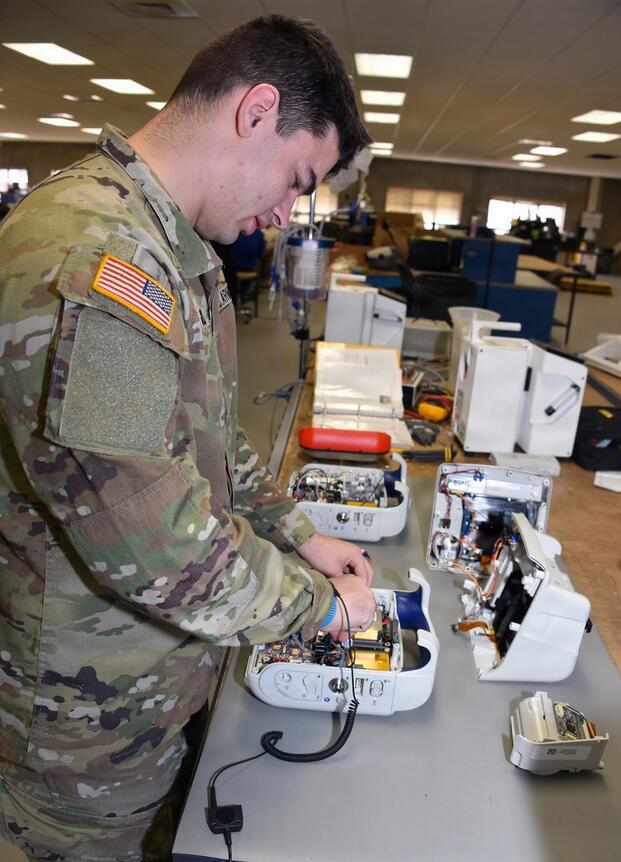
So far, MMOD personnel are using AI for administrative tasks. But in the future, the possibilities could be endless.
“As the program matures, we see tremendous opportunity to contribute our specialized medical equipment data into [AI],” Newman said. “This will ensure the platform is finely tuned for the unique needs of Army medicine, ultimately benefiting the Soldiers who rely on this equipment.”
The Army’s Medical Maintenance Management Directorate, or M3D, is also jumping on the AI bandwagon, with training sites in California, Pennsylvania and Utah, under the Army’s Communications-Electronics Command.
“Our modernization efforts are in lockstep with CECOM’s strategic vision,” M3D Director Jorge Magana said in a statement obtained by Military.com. “By empowering our teams to embrace technologies like AI and remote support, we are building a more resilient sustainment enterprise that directly contributes to CECOM's goals and delivers readiness for the entire Army.”





