

Venezuelans awoke Friday to mounting reports that a narrow stretch of coastline near its border with Colombia may have been the target of a U.S. military strike — a move that would mark a sharp escalation in Washington’s pressure campaign against the Nicolás Maduro regime.
The suspected strike occurred in the western reaches of the Gulf of Venezuela, between Puerto López in Colombia’s La Guajira region and the Wayuu community of Poshoure in Venezuela’s Zulia state, according to local and international media citing witness accounts. Analysts say the area has long been associated with illicit maritime trafficking and, more recently, with cocaine shipments moving through the Caribbean.
Residents along Colombia’s La Guajira coast reported hearing a powerful explosion in mid-December that shattered the stillness of a windless afternoon. Moments later, plumes of dark smoke rose from the sea, prompting residents to record what appeared to be the aftermath of an airstrike. The footage circulating on social media marks the first visual evidence linked to the U.S. counternarcotics campaign in the region.
Two days later, debris washed ashore near Puerto López. According to residents and local officials, the wreckage included a burned vessel roughly 30 meters long, two severely damaged bodies, and scattered debris such as charred fuel drums, life vests, and dozens of empty packages. Some of the packages contained traces of a substance that smelled like marijuana.
The Telemundo television network later broadcast images of twisted metal fragments recovered on the Venezuelan side of the border, in the Alta Guajira region. Weapons experts cited by the network said the debris appeared consistent with components from a U.S.-made AGM-114 Hellfire missile or its newer AGM-179 Joint Air-to-Ground Missile variant, both commonly deployed from MQ-9 Reaper drones and U.S. attack helicopters.
Those reports appear to corroborate statements made Monday by President Donald Trump, who said the United States had destroyed a docking area used by suspected drug traffickers in Venezuela, marking the first public acknowledgment of a U.S. ground strike inside the country.
“There was a big explosion in the dock area where they load the boats with drugs,” Trump said while speaking to reporters at his Mar-a-Lago residence in Florida during a meeting with Israeli Prime Minister Benjamin Netanyahu.
The president did not specify whether the operation was carried out by U.S. military forces or intelligence agencies, nor did he identify the precise location of the strike, saying only that it occurred “along the coast.” He also declined to say whether there were casualties.
The reports come as the United States expands what officials have described as “Operation Southern Spear,” a months-long campaign targeting drug trafficking networks across the Caribbean and eastern Pacific. U.S. authorities say the operation has destroyed at least 35 vessels and resulted in more than 100 deaths over the past five months. On Dec. 31, the Pentagon confirmed strikes on three additional boats it said were linked to narcotics trafficking.
If confirmed, the apparent strike in Venezuela would mark the first known instance of U.S. forces hitting a land-based target inside the country as part of the campaign.
Members of Venezuela’s Wayuu indigenous community told NBC News and Telemundo that they witnessed a powerful explosion on Dec. 18 in the remote Alta Guajira region, where armed groups — including Colombia’s National Liberation Army (ELN) — operate. The blast destroyed a structure believed to be used for storage, according to witnesses. The ELN has long been involved in cross-border drug trafficking and maintains a presence on both sides of the border.
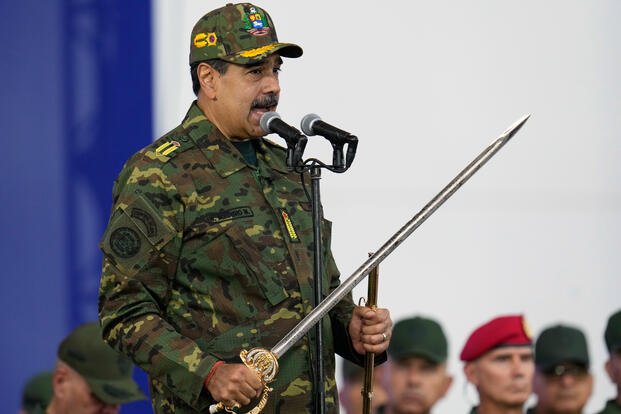
Venezuelan authorities have neither confirmed nor denied that an attack occurred on land. In a televised address Thursday, Maduro said the country’s defense systems “guarantee territorial integrity” when asked about reports of a U.S. strike.
“Our national defense system, which unites the people, the military and the police, guarantees peace and territorial integrity,” Maduro said, adding that he would address the matter in greater detail “in the coming days.”
Maduro again denied that Venezuela produces illegal drugs and said his government remains open to discussing a counternarcotics agreement with Washington. “If they truly want to talk seriously about fighting drug trafficking, we are ready,” he said.
Both Venezuela and Colombia have condemned the U.S. operations as unlawful and have accused Washington of carrying out extrajudicial killings. The United Nations has warned that the strikes could violate international law and has urged the United States to stop them.
Meanwhile, satellite imagery from Europe’s Sentinel-2 system dated Jan. 1 shows the USS Gerald R. Ford, the U.S. Navy’s largest aircraft carrier, operating 227 nautical miles north of Caracas. The carrier strike group is part of a growing U.S. military presence in the region that includes guided-missile destroyers, amphibious vessels and an estimated 15,000 troops.
U.S. officials say the deployment is aimed at dismantling drug trafficking networks, including the so-called Cartel de los Soles, which Washington alleges is run by Maduro along with senior figures of his regime. Caracas has repeatedly denied the accusation, even as tensions between the two countries continue to escalate.
©2026 Miami Herald. Visit miamiherald.com. Distributed by Tribune Content Agency, LLC.





