


Eyes across the nation and around the world will be glued to this Sunday’s Super Bowl matchup between the New England Patriots and Seattle Seahawks. Meanwhile, members of the U.S. Armed Forces will be busy assuring that the game will go off without a hitch.
On Feb. 8, the Air Force and Navy will collaborate on a special multi-aircraft flyover to commemorate the United States’ 250th birthday ahead of Super Bowl LX at Levi’s Stadium in Santa Clara, Calif. The massive event that has captivated Americans and foreign viewers alike for six decades relies on countless individuals behind the scenes, including members of the North American Aerospace Defense Command (NORAD) who guard the seas and the skies from any potential threats before, during and after the game.
NORAD is a bi-national defense organization that includes Americans and Canadians and took off in the 1950s, launching aerospace- and maritime-oriented missions to protect the broader continent. That includes the detection, validation and warning of attack against North America by aircraft, missiles or space vehicles.
Their involvement in the Super Bowl has been decades long, defending airspace before, during and after the game. Heightened security for the Super Bowl began post-September 11, 2001.
“Overall, we know what our objective is,” Lt. Col. Jeffrey Brandon told Military.com. “We build a gameplan to achieve that objective, and then we ensure we do that via redundancy and communication.
“That's really what we're doing across the entire NORAD, is making sure everybody's on the same page. So, when it is time to be in position, we're all where we should be.”

This year’s formation features two Air Force B-1 Lancers, from Ellsworth Air Force Base in South Dakota; two F-15C Eagles, from Fresno Air National Guard Base in California; a pair of Navy F/A-18E Super Hornets and two F-35C Lightning IIs, from Naval Air Station Lemoore in California.
Along with the Air Force, Navy and NORAD, airpower and maritime strength will be exuded by additional branches including the Army, Marine Corps, Space Force and Coast Guard.
'Always Training'
Brandon, a pilot, is also a maintenance squadron commander with the California Air National Guard's 144th Fighter Wing who is playing a different role than others as it pertains to this Sunday’s festivities and the days preceding it.
That role entails monitoring and alerting any actions or behaviors that may jeopardize the Super Bowl or pose any safety threats. That involves working hand in hand with the Federal Aviation Administration to develop event-specific strategies that go beyond normal protocols.
NORAD is a 24-7-365 operation where service members in the air and on the ground monitor and enforce temporary flight restrictions (TFRs).
“We're always training for stuff like this,” Brandon said. “The Super Bowl is a new one personally for me. But overall, our job is to be ready for any of these events or engagements that do come up around the year.”
Brandon’s role in this year’s Super Bowl is almost by chance, he said, acknowledging that all pilots on the team are trained and prepared to enforce TFRs when called upon. It just so happened that he was selected, tasked and assigned to oversee protocols.
As to the window for the TFR, that is decided and implemented by the FAA—which passes procedures to NORAD to ensure safety. The Notice to Airmen, or NOTAM, for the Super Bowl is before and after the event itself.
NORAD has multiple different aircraft in its arsenal that are available to do airborne civil air patrol, including the F-15C Eagle and F-16. However, a NORAD spokesperson told Military.com that due to operational security reasons, they don't announce which units are actively going to be doing events prior to their happening.
TFRs and a Foolproof Plan
As the players, coaches and staff of the two Super Bowl squads conduct their final walkthroughs to get ready for the biggest game of the year, similar actions are taking place on the military side as well.
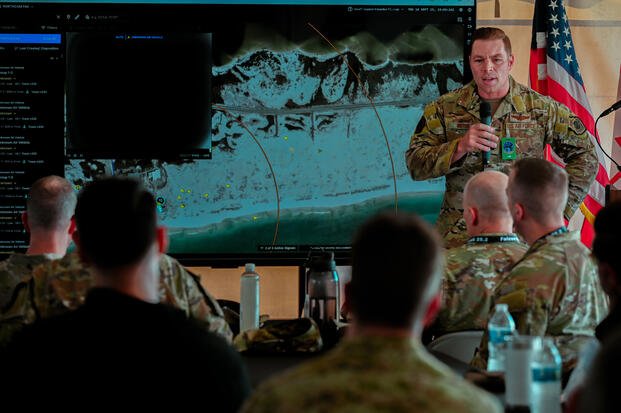
“We'll get a tasking or are informed of something that we expect to do the security for, whether TFR or anything else,” Brandon said. “And the first thing we do is we start understanding the problem. So, what's that TFR around? What is around it? What is the general city or the location of the TFR?"
Then, we start doing our training, preparing via training flights. Just like the players are practicing and training for the game, we're practicing and preparing for our execution in the skies.
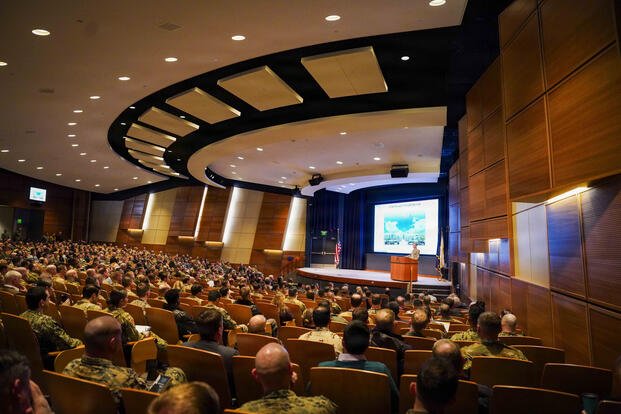
NORAD is “a massive endeavor” that can often go under the radar, no pun intended. It involves U.S. and Canadian members who are pilots, maintainers, controllers and others. NORAD extends into the Air Operation Center and individual alert sites at myriad locations—culminating in hundreds of people all working together to provide safety and security in the region.
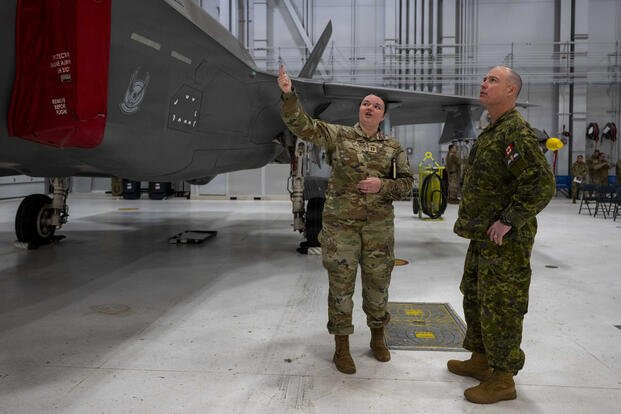
If a problem arises, it is usually trained for in advance. Brandon said that protocols in place may not always mimic past events and TFRs, but the overall objective remains consistent: achieving success via redundancy and communication.
“We're going to come up with a plan, and then we're going to practice that plan,” he said. “And then we're going to brief, execute, and then debrief to our execution to make sure that we not only did what we intended to do, but if we did have any situations we wish we could have done better, we'll debrief to it so the next time we get even better."
Whether it's the Super Bowl TFR or really any TFR, we do the same thing. That's how we get so good at it, is we practice and we practice and we practice to ensure we do it right the first time.
The TFR around Santa Clara for Sunday’s game is roughly 30 miles, though Brandon said that tends to vary based on stadium and location. The FAA oversees that as well.
Special Procedures and the ‘No Drone Zone’
The FAA in recent days has issued multiple resources warning pilots and other machine operators to follow TFRs and avoid the airspace in lead-up to the game.
That has included cautioning general aviation pilots flying in the San Francisco Bay Area from Feb. 4-10 to be aware of temporary flight restrictions, to follow special air traffic procedures comprised of specific arrival and departure route requirements, and to comply with additional operational requirements in effect.
The FAA said those air traffic procedures “to minimize delays and ensure safety” will be in effect for the following airports:
- San Francisco International Airport (SFO)
- Oakland International Airport (OAK)
- San Jose International Airport (SJC)
- Hayward Executive Airport (HWD)
- Livermore Municipal Airport (LVK)
- Moffett Federal Airfield (NUQ)
- Napa County Airport (APC)
- Buchannon Field Airport (CCR)
- Monterey Regional Airport (MRY)
- Salinas Municipal Airport (SNS)
- Palo Alto Airport (PAO)
- San Carlos Airport (SQL)
- Reid Hillview Airport (RHV)
- Stockton Metro Airport (SCK)
- Watsonville Municipal Airport (WVI)
- Hollister Municipal Airport (CVH)
- Half Moon Bay Airport (HAF)
A Super Bowl-specific FAA webpage goes into more detail to provide aircraft operators information about parking reservations, air traffic control towers, and traffic. Flight plans, for example, must be filed at least six hours, but not more than 24 hours, prior to the proposed time of departure.
“The FAA works with law enforcement, the aviation community and the National Football League to ensure safe, secure and efficient aircraft operations for Super Bowl LX,” an FAA spokesperson told Military.com. “In coordination with the FBI, the FAA has established a ‘No Drone Zone’ for the Super Bowl at Levi’s Stadium in Santa Clara, California, with additional drone restrictions in downtown San Francisco during the days leading up to the event.”
That “No Drone Zone” involves detection, tracking and assessing unauthorized drone activity, with personnel from the FBI and FAA deployed full-time to identify drone activity that could threaten aviation safety, critical infrastructure, or public safety at and around event venues.

There is a hefty price for those who don’t follow the law, with drone operators who enter restricted airspace without authorization facing fines of up to $75,000, drone confiscation, and federal criminal charges. The FBI in such instances will identify operators, seize drones and support prosecution.
“Realistically, the big thing that I want people to understand is if you find yourself in that situation, just comply, listen to what we're telling you to do, and do your very best to do your homework,” Brandon said. “Be calm, cool, collected in the moment, and we will do everything we can to help alleviate the situation.”
Protocols to Address Airspace Violations
This begs the question: What happens if an unauthorized aircraft or drone violates restricted airspace?
Brandon described the process should that occur, saying that a typical engagement with a track of interest will depend if NORAD pilots are airborne or not.
If they’re on the ground, pilots will be advised by the defense sector—which will inform whether there’s a “need to scramble.”
“And then in minutes, we'll get airborne and then we'll be on our way to that track of interest,” Brandon said. “If we're already airborne, then we'll just get a point out from the controlling entity and then we'll go to rejoin with that aircraft or whatever that area of aircraft or UAV [Unmanned Aerial Vehicle] or whatever it ends up being."
From there, pilots will intercept whatever entity is in that restricted airspace. It’s the pilots’ responsibility to safely rejoin and then get visuals on the crafts in question. That means contact attempts via radio, as well as air traffic controllers from the FAA also attempting to communicate.
“And if none of those have any effect or we're not able to make contact that way, then we'll actually rejoin into a visual formation,” he added. “So, just if they're looking outside, they're going to see an aircraft outside of their aircraft and we're going to rejoin them and then try to communicate that way.”
Communication attempts are coupled with efforts for the pilots to guide the unauthorized crafts out of the TFR, which Brandon said often happens “by accident.”
Once that craft is out of the TFR, they can communicate with ATC and then follow the directions from them.
“I would say most of the engagements are people [who] didn't realize or didn't know, didn't check the NOTAMs, and they found themselves in a spot—whether due to the aircraft malfunction or their own unknowingness in a spot they didn't want to be,” he said, adding that such individuals normally acknowledge their mistake and move along.





