


On the afternoon of Oct. 4, 1918, American artillery hit a ravine in France's Argonne Forest. The rounds were falling directly on roughly 500 U.S. soldiers that had been trapped behind enemy lines for two days. Maj. Charles Whittlesey, a New York lawyer commanding the surrounded force, had one way left to stop the bombardment. His life and the lives of his men now rested on a lone carrier pigeon.
That bird, a black check homing pigeon named Cher Ami, flew 25 miles through gunfire with a message attached to his wounded leg. The flight helped save hundreds of American soldiers and made Cher Ami one of the most recognized animals in U.S. military history.
Trapped in the Argonne
The Meuse-Argonne Offensive was the largest American military operation of World War I. Launched Sept. 26, 1918, it sent more than a million U.S. troops against fortified German defenses in northeastern France.
The 77th Infantry Division, nicknamed the "Metropolitans," filled its ranks from New York City draftees. Chinese, Polish, Italian, Irish, Greek, Russian, German and Jewish Americans joined the unit, many of them immigrants or first-generation citizens from Manhattan's Lower East Side.
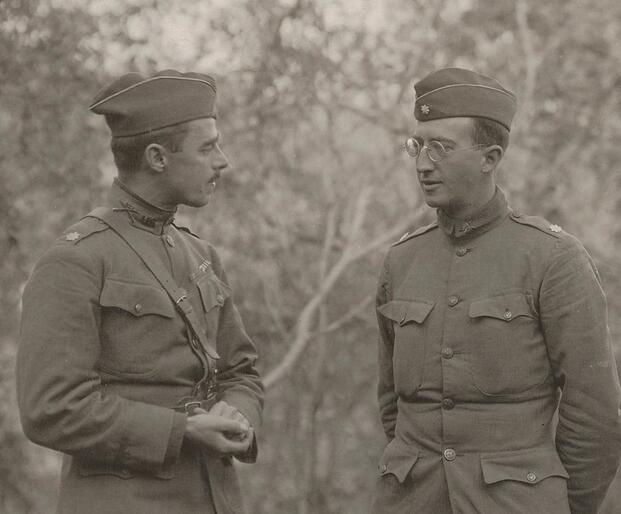
On Oct. 2, Whittlesey led elements of the 308th Infantry Regiment into the dense Argonne Forest alongside Capt. George McMurtry's 2nd Battalion. McMurtry was a veteran of the Spanish-American War who had ridden with Theodore Roosevelt's Rough Riders. Both officers had reservations about the attack.
Before stepping off, Whittlesey told his regimental commander, "All right, I'll attack, but whether you'll hear from me again, I don't know."
Their orders were to advance north and seize a road near the Charlevaux Ravine. On a foggy morning, they pushed forward and captured their objective. But French forces on their left flank and another American division on their right both failed to keep pace. German troops recaptured ground behind Whittlesey's men overnight and sealed the gap. By dawn on Oct. 3, roughly 554 Americans were completely encircled.
They became known as the "Lost Battalion."
Capt. Nelson Holderman reached the pocket that morning with Company K of the 307th Infantry, adding his men to the surrounded force. German snipers, machine guns, grenades, trench mortars and flamethrowers hit the American position from nearly every direction over the next few days.

Pigeons on the Western Front
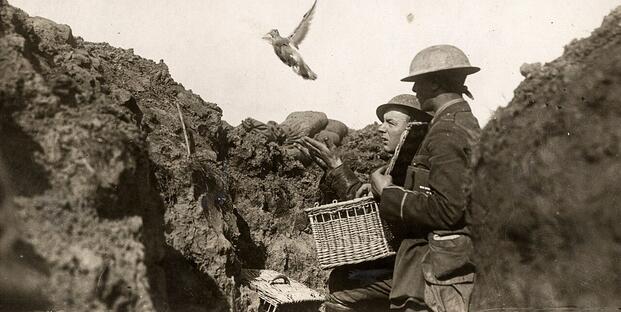
The U.S. Army Signal Corps deployed roughly 600 British-bred homing pigeons to France in May 1918. Radios on the Western Front were bulky and tethered to fragile wires. Telephone lines were constantly severed by artillery. Human runners made easy targets for snipers and machine guns.
Over the previous decades, military forces around the world had experimented with using carrier pigeons for transmitting messages. As WWI radios proved unreliable, pigeons helped fill the gap, flying at speeds near 50 mph and navigating home across unfamiliar terrain. An estimated 95% of pigeon-carried messages on the Western Front ultimately reached their destination.
German machine gun crews were trained specifically to spot and shoot down Allied pigeons. Killing an enemy bird meant the prevention of reinforcements or artillery support. For soldiers in the trenches or behind enemy lines, pigeons were the difference between life and death.
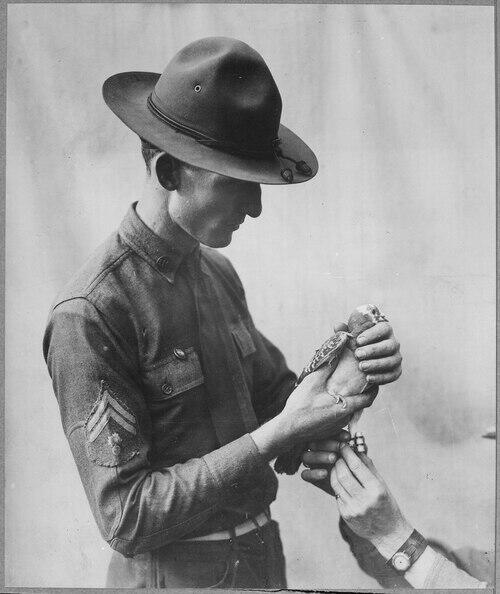
Whittlesey had no functioning radio and no way to run telephone wire through the German lines. His only communication link to division headquarters was a small collection of homing pigeons carried by Pvt. Omer Richards of New York, a member of the 308th who served as the unit's pigeon handler.
'For Heaven's Sake Stop It'
Over Oct. 3 and 4, Whittlesey sent several pigeon messages requesting reinforcements and supplies. One early message contained inaccurate coordinates, something the American artillery would inadvertently use.
On the afternoon of Oct. 4, American artillery batteries, unaware of Whittlesey's actual position, opened up a barrage intended for German lines. The rounds struck the American pocket instead. The friendly fire killed approximately 30 soldiers and wounded dozens more.
Whittlesey ordered Richards to prepare a pigeon. A shell blast startled the handler and one of the two remaining birds escaped. Richards reached for the last pigeon in his basket. It was Cher Ami, a British-bred bird who had already completed 12 successful missions flying from the Verdun front. His name was French for "Dear Friend."
Whittlesey scrawled a message and Richards attached it to the pigeon's right leg. The note read, "We are along the road parallel 276.4. Our own artillery is dropping a barrage directly on us. For heaven's sake stop it."
Richards released Cher Ami. The bird landed on a nearby branch and refused to move. Richards climbed the tree and shook the limb until the pigeon took off.
Cher Ami's Flight
German soldiers spotted Cher Ami rising from the American position and opened fire with rifles and machine guns. A bullet or shrapnel tore into Cher Ami's breast and struck his right leg, nearly severing it. The pigeon dropped.
Then Cher Ami got airborne again. With a severe chest wound and his right leg hanging by a single tendon, the message canister still attached, the bird flew southwest toward the division's Mobile Loft No. 11 at Rampont. He covered 25 miles in roughly 25 minutes.
When Cher Ami arrived at the loft, he was on his back, covered in blood, with the message dangling from what remained of his leg. Army medics saved his life but could not save the leg. It had to be amputated.
The American shelling stopped. Whittlesey's note gave the division the exact coordinates of the surrounded force.
The Rescue
Over the next three days, the trapped Americans continued to fight off German assaults. American planes attempted to drop food, ammunition and medical supplies to the pocket, but nearly every package missed and fell into German hands.
On Oct. 7, a blindfolded American prisoner named Pvt. Lowell Hollingshead was sent back into the pocket carrying a white flag and a German note urging surrender. It read, "The suffering of your wounded men can be heard over here in German lines, and we are appealing to your humane sentiments to stop. Please treat Private Lowell R. Hollingshead as an honorable man. He is quite a soldier. We envy you."
American newspapers later claimed Whittlesey shouted "Go to hell!" in response. He denied it. In his official report, the major wrote that no reply seemed necessary. Instead, he ordered every white panel on the hillside pulled in so the Germans would not mistake them for surrender flags. He told his men to prepare for another attack.
That same day, Pvt. Abraham Krotoshinsky, a Polish-born Jewish immigrant serving with the 308th, volunteered to slip through the German lines as a runner. He made it through. Krotoshinsky reached American forces and helped guide the relief column toward Whittlesey's position. He received the Distinguished Service Cross.
When American troops broke through the encirclement on the evening of Oct. 7, the losses were significant. Of the original force, 107 men had been killed, 63 were missing and 190 were wounded. Only 194 soldiers walked out on their own.
L.C. McCollum, a Lost Battalion survivor, later wrote that the leadership of Whittlesey and McMurtry during those days "was something wonderful to see. It instilled into the hearts of their men that undying faith of purpose, the courage to go ahead against overwhelming odds."
Cher Ami's Legacy
Cher Ami survived his wounds. The French government awarded him the Croix de Guerre with palm for gallantry. Members of the Lost Battalion carved a small wooden leg for the bird. Gen. John Pershing, commander of the American Expeditionary Forces, said, "There isn't anything the United States can do too much for this bird."
Under the care of his trainer, Capt. John Carney, Cher Ami sailed for the United States on April 16, 1919. He was housed at Camp Alfred Vail, later renamed Fort Monmouth, in New Jersey. His chest wound never fully healed. Cher Ami died on June 13, 1919.
The U.S. Army Signal Corps donated his remains to the Smithsonian Institution. Taxidermist Nelson R. Wood preserved the bird, and Cher Ami went on public display in June 1921. He was posthumously inducted into the Racing Pigeon Hall of Fame in 1931 and received the Animals in War and Peace Medal of Bravery in 2019.
For a century, one detail remained unresolved. Army records from the era listed Cher Ami as a female hen, while the Smithsonian labeled him a male. In 2021, the museum conducted DNA testing on tissue samples from the pigeon's remains. Cher Ami was confirmed to have been male.
The Cost of Command
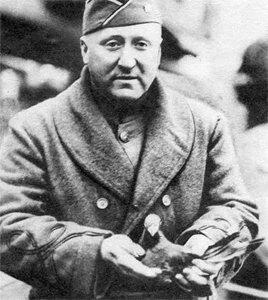
The story of the Lost Battalion captured the attention of Americans everywhere as newspaper headlines repeatedly told the story of their survival. Whittlesey and his men despised the name. They were exactly where they had been ordered to go, the other units failed to keep up. The survivors preferred the term "surrounded battalion."
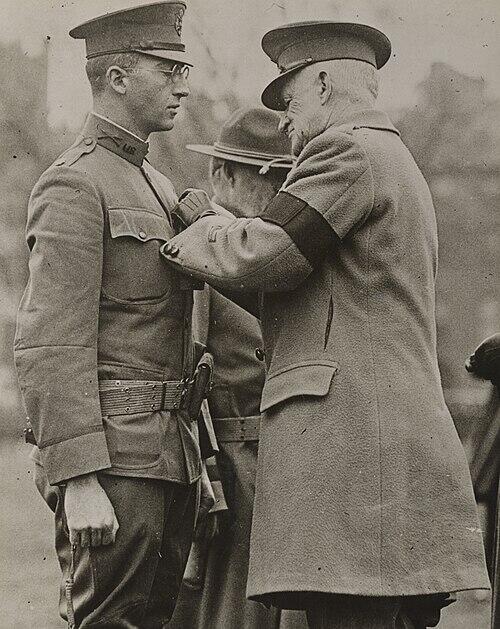
Whittlesey, McMurtry and Holderman all received the Medal of Honor for their actions in the Argonne. Whittlesey returned to his law practice in New York, but was flooded with speaking invitations and parades. He hated the attention. He deflected every public appearance toward praising the enlisted men who served alongside him.
On the night of Nov. 26, 1921, Whittlesey disappeared from the USS Toloa while traveling from New York to Havana. His body was never recovered. He had prepared a will before the voyage, leaving the original German surrender note to McMurtry.
Col. Nathan K. Averill said at his memorial that Whittlesey's death "was in reality a battle casualty and that he met his end as much in the line of duty as if he had fallen by a German bullet."
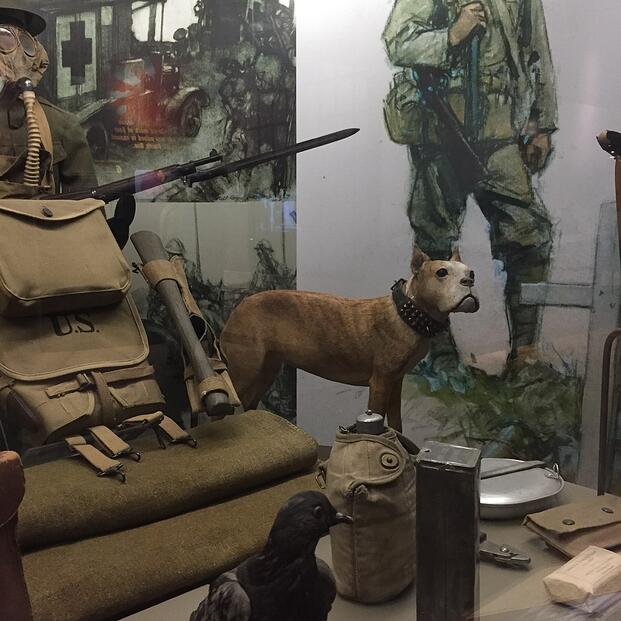
Cher Ami is still on display at the Smithsonian's National Museum of American History. He stands on his wooden leg in the "Price of Freedom" exhibition.
Alongside Sgt. Stubby and Chips the War Dog, Cher Ami remains on the most iconic and heroic animals to have ever served alongside American troops.





")
